Search This Blog

Saturday, January 22, 2011

IMITATION BLACK

I swear its things like this that make fangirls go crazy and turn regular guys into homosexuals. It's still a nice song despite that.


I especially enjoy the cover by Clear, Dasuko, and Valshe:


Lyrics 

歪んだ日常 許されない愛

 yuganda nichijou yurusarenai ai

偽りの心
itsuwari no kokoro
黒く塗りつぶされた 不完全な愛
kuroku nuritsubusareta fukanzen na ai
漆黒の世界
shikkoku no sekai

ずっとキミに言いたかった
zutto kimi ni iitakatta
たった一つの言葉なのに
tatta hitotsu no kotoba na no ni
抑えきれない衝動が
osaekirenai shoudou ga
壊れてしまうのなら
kowarete shimau no nara

愛し愛され 狂いそうなほどに
aishi aisare kuruisou na hodo ni
甘く熱いくちづけは IMITATION
amaku atsui kuchizuke wa IMITATION
麻痺する感覚 遠くなる意識
mahi suru kankaku tooku naru ishiki
溢れる想いと真実
afureru omoi to shinjitsu
黒で塗り潰して
kuro de nuritsubushite

沈んでいく月が雲と重なって
shizundeiku tsuki ga kumo to kasanatte
まるで影を隠すように
marude kage o kakusu you ni
もう戻れないの?
mou modorenai no?
このまま二人で消えてしまおう
kono mama futari de kiete shimaou

いつか君と結ばれると
itsuka kimi to musubareru to
信じて手を離したのに
shinjite te o hanashita no ni
自分らしさのない愛なら
jibun-rashisa no nai ai nara
壊してしまえばいい
kowashite shimaeba ii

きつく強く抱きしめて欲しくて
kitsuku tsuyoku dakishimete hoshikute
重なる体の温度は IMITATION
kasanaru karada no nukumori wa IMITATION
太陽が照らし 僕を困らせるから
taiyou ga terashi boku o komaraseru kara
君が見えなくなる
kimi ga mienaku naru
Please teach me the answer?

常識もモラルもぶち壊し
joushiki mo moraru mo buchikowashi
罰を受けるのは僕だけでいい
batsu o ukeru no wa boku dake de ii
最期にキミが言った
saigo ni kimi ga itta
言葉を抱いて
kotoba o daite

いつの日もキミを思うよ
itsu no hi mo kimi o omou yo
抱きしめた肩の感触
dakishimeta kata no kanshoku
溶けて消えて無くなる前に
tokete kiete nakunaru mae ni
キミに会いに行くよ
kimi ni ai ni yuku yo

ゆらり揺らめく 幻想に抱かれ
yurari yurameku gensou ni idakare
君に言った言葉は IMITATION
kimi ni itta kotoba wa IMITATION
冷たい肌に 消えない口痕
tsumetai hada ni kienai kizuato
記憶のすべて何もかも黒に沈めて
kioku no subete nani mo ka mo kuro ni shizumete
堕ちていく
ochite yuku

愛し愛され 狂いそうな程に
aishi aisare kuruisou na hodo ni
甘く熱いくちづけは IMITATION
amaku atsui kuchizuke wa IMITATION
麻痺する感覚 遠くなる意識
mahi suru kankaku tooku naru ishiki
溢れる想いと真実
afureru omoi to shinjitsu
黒で塗り潰して
kuro de nuritsubushite


Friday, January 21, 2011

ボランティア 三日目

1:02 - Sign in computer not working; signed in using the sign in sheet

1:14 - Noticed a new wet floor sign; probably put there for legal purposes. Slippery floor is slippery.

1:18 - A doctor not on the list? What is this madness?

1:23 - The linearity of buildings is amazing but the complexity of departments in those buildings are quite baffling.

1:38 - Although I know how to get around this building, I'm rather useless for directions to departments to other buildings.

1:40 - Found my mini-map a bit too late

1:57 - First lab question of the day; slow day is slow

2:27 - Suddenly, people asking for help!

2:47 - Asking for help in Cantonese is always a challenge for me.

2:49 - There seem to be an influx of people asking for locations not in this building, thus making my job much more difficult.

2:53 - Return of the LIST!

3:02 - Yellow pages to the rescue

3:08 - A treadmill what test? Something cardiology related probably.

3:21 - To my knowledge, this building has no notice boards

3:25 - There was no mailing room; delivery guy was full of rage

3:26 - X-rays happen in most buildings; hard to redirect if it's not in this building

3:56 - Ultrasounds are ultra

4:00 - And then there was none


Thursday, January 20, 2011

バイアスシャッフル - 前編

This will be post 1 of a series of posts dedicated to Bias Shuffling, otherwise known as Card Stacking. Stacking cards is a common practice in order to give yourself an advantage when playing card games. The position of cards relative to others in the deck at an initial starting series will tend not to deviate much from the norm given that shuffling is done systematically. In other words,  you aren't really "shuffling"; you are merely displacing the cards in an orderly fashion. In order to truly achieve randomization, certain shuffling techniques, as well as randomization within those techniques, must be done. They must also be done with enough repetitions such that the majority of cards have somewhat deviated from the initial starting series.

Consider a standard deck of playing cards. We remove all the jacks, queens, and kings, in order to make this a deck of 40 (For our purposes of making analogies with Yu-Gi-Oh). Initially, all the cards are ordered from lowest to highest (Ace is a 1 in this case), and from lowest to highest suit (Diamond, Club, Heart, Spade):


So our initial sample space is then:

Si=[1D, 1C, 1H, 1S, 2D, 2C, ... 10S]

From an intuitive point of view, the probability of drawing a certain card (Such as Ace of Spades or 5 of Clubs) would be 1/40. If we did no shuffling whatsoever, we would draw the cards in the order of the series.

Let us now dissect the three types of shuffling that will be most common in trading card games: Standard, Cascade, and Pile shuffling. This week we'll go over the most common; Standard.


Standard: This is basically the practice of taking the majority of cards in the middle of the deck out, allowing the remaining cards at the top to fall onto the bottom of the cards. The majority taken out is then either placed back onto the top (more common) or the bottom. The process is repeated several times to ensure a "thorough" shuffle.


In this experiment, we will perform Standard shuffling 5 times and see where certain test cards are relative to other cards (We will use 4 test cards of equal intervals: 2D, 4D, 6D, 8D). In experimental conditions, the amount of top and bottom cards will remain constant, at 5 each, so that each shuffle will remove 30 cards from the middle and replace them back on the top. Finally, after the fifth time, we will cut the deck at card #20. In this kind of experiment with a predetermined outcome, repetitions are not necessary.

Let us see now what are deck looks like:


Sf=[3S, 4D,...7C, 9S, 10D, ...10S, 7H, 7S, ...9H, 1D, ...3H]

Ellipses represent no change in order, whereas when a number is listed is where that number has deviated from it's original position.

Check our 4 test cards relative to the two cards from the left and from the right of it.

2D: 1H, 1S; 2C, 2H
4D: 3H*, 3S; 4C, 4H (* denotes that the deck reaches one end and continues the series from the other)
6D: 5H, 5S; 6C, 6H
8D: 7H, 7S; 8C, 8H

There seems to be no deviation from the norm at all. But I already knew the result of the experiment; that's why I picked those particular values (No coincidence they are all even numbers too). If we were to pick one of our bolded values from before (9S, 7H, 1D) we would notice that their positions relative to their original has deviated a bit, though not to an extreme.

Of course repeating the experiment in the reverse manner would yield your initial result of all cards back in order (Assuming you reverse your cut first). However, this systematic shuffling procedure doesn't give us a clear representation of how random it can get, which is what we are truly interested in.

I will now perform the same experiment, starting back to my original Si series order, and will do it 5 times as before. This time it will be random; I will not record how many cards I take from the middle, and I will not cut the deck exactly halfway (Granted cutting at card 20 isn't exactly half, but it was either 20 or 21; I picked the even number). Once again, I will cut the deck after the fifth shuffle. Note that Standard shuffling sometimes involves not leaving any cards at the top, or not leaving any cards at the bottom. Since there is no longer a series of cards for the top (or bottom) of the cards to shift to, this form of Standard shuffling is considered "Cutting the deck". As such, each displacement in the experiment always left at least one card at the top and one card at the bottom.

Sf=[5D, 5C, ... 6C, 8H, 8S, 9D, 2D, 10C, 10H, 10S, 7H, 7S, 8D, 8C, 3C, 3H, 3S, 6H, 6S, 9C, 9H, 9S, 7D, 7C, 10D, 1D, 1C, 2C, 2H, 2S, 3D, 1H, 1S, 4D, 4C, 4H, 4S]

Obviously, the more "random" our procedure is, the more numbers that deviate from their original position. Let us compare our 4 test points:


2D: 8S, 9D; 10C, 10H
4D: 1H, 1S; 4C, 4H
6D: 5H, 5S; 6C, 8H
8D: 7H, 7S; 8C, 3C

Bolded values are those that do not match our previous experiment. The relative frequency of deviation then, appears to be 8/16, 0.5, or 50%, for this particular experiment. This isn't to say that other such experiments would not yield 50%, but what we are saying is that only by performing an infinite number of repetitions can we get a "true" percentage of randomization.

We could be satisfied with with this result; half my cards are separated each time I shuffle before a new game. Sometimes that is a good thing; certain cards can perform combos with each other. However, the inverse is for the most part more damaging; having similar cards together, which commonly results from bias shuffling, won't leave you with any options in a duel.

Next week we'll go over Cascading, which attempts to fix this problem of the lack of deviation.


Wednesday, January 19, 2011

私は草 / I am the Grass

Take this essay I wrote about Walt Whitman’s “Song of Myself (Section 6)”. It got a 4.5/5, because I made many tiny mistakes, but it's still pretty good.


Link to the poem: http://www.princeton.edu/~batke/logr/log_026.html


I am the Grass, Let Me Work
There is no doubt that grass is one of the most common things found in nature. It is a simple plant that grows almost everywhere. Grass is often associated with nature, and as such, has connotative meanings relating to life. However, in Walt Whitman’s “Song of Myself (Section 6)”, Whitman makes several points about both the process of life and the process death by relating them to grass.
Section 6 of “Song of Myself” begins with a child asking “What is the grass?” (Whitman, 1). The persona is baffled by the question; he admits that he does not “…know what it is any more than he.” (Whitman, 2). These beginning two lines have set the foundation that the reader should think beyond the denotative meaning of grass; it is not just a green plant that grows on our lawns.
Whitman starts his comparison of grass to the cycle of life with a metaphor and an allusion to God. The persona claims that grass “…is the handkerchief of the Lord” (Whitman, 4). A handkerchief is a piece of cloth used to wipe clean the mouth after a meal or to blow your nose with. But why would God need such a trivial item? This metaphor is a way to delineate that the grass does the work of God; it essentially cleans up the dead so that new living things can thrive.
Right after relating the grass to death, the persona then uses another metaphor to compare the grass to a child, “…the produced babe of the vegetation” (Whitman, 7). Children, like nature, have connotative meanings relating to life. A child is also innocent in the sense that they are new to the world and that there is still much for them to learn. Therefore, it is no coincidence that it was a child who posed the initial question “What is the grass?”
As the poem progresses, Whitman shifts to a more grim perspective of the grass, and the connotations of death become more apparent. In stanza eight, the persona ponders the origin of the grass, and what kind of people might have been buried under it. The reader is presented with a morbid thought that the grass may be “…from offspring take soon out of their / mothers’ laps,” (Whitman, 16-17). However, Whitman ends the stanza with a positive point: “And here you are the mothers’ laps.” 
(Whitman, 18). Whitman once again juxtaposes life and death in this stanza; grass may grow on the dead, but grass itself harbours life.
As an aside, Whitman has not been the only poet to associate grass with death. Carl Sandburg’s “Grass” was written after World War I and shares a similar view about the topic. Two lines in particular are of interest in Sandburg’s poem: “I am the grass; I cover all” (Sandburg, 3), and “I am the grass. / Let me work.” (Sandburg 10-11). The first line suggests that the grass covers all the buried bodies from the war. The war victims may have died of different reasons, but in the end their bodies end up in the soil like the rest of the deceased. The second line’s message is simply stating that grass growing is a natural process, and it shouldn’t be questioned.
Going back to Whitman’s “Song of Myself (Section 6)”, the similarities to Sandburg’s “Grass” can be seen in the final stanza. Whitman ends the poem by stating “All goes onward and outward, nothing collapses, / And to die is different from what any one supposed, and luckier” (Whitman, 31-32). Similar to the ending of “Grass”, Whitman’s message is that death is a natural process and it shouldn’t be questioned. Grass does not stop growing if one blade of it is cut. Likewise, the world does not stop moving if one person dies. The final line of Section 6 of “Song for Myself” is left as an enigma for the readers to interpret. However, the main point to take from this poem is that although death may be melancholic, it gives rise to life, the most precious thing in the world.

Tuesday, January 18, 2011

電気力とベクトル / Electric Force and Vectors

On really really busy days, and I have no topic, I'll resort to solving homework questions and posting them. It's a two-for-one deal really; I keep my at least 1 post per day, and I help myself learn the concept. Oh, and I guess if someone finds this online it'll help them too. Because when considering Physics, everyone loses.

Consider three point charges, Q1, Q2, and Q3 as shown in the isosceles triangle below:

What is the magnitude and direction of the electric force on Q3?

First thing you should do is find the remaining values for your triangle. You are already given the lengths of each side, so by using that, you can find the angles inside the triangle, which will be used later.

Recall the general form of the Pythagorean Theorem: The Law of Cosines:


a2 + b2 – 2*a*b*cos(C) = c2
We can use this formula to determine the interior angles:

0.502 + 0.502 – 2(0.50)(0.50)cos(α) = 0.362
(0.362 - 0.502 - 0.502) / - (2(0.50)(0.50)) = cos(α)
cos(α) = 0.7408
cos-1(0.7408) = 42.2

0.362 + 0.502 – 2(0.50)(0.36)cos(β) = 0.502
(0.502 - 0.362 - 0.502) / - (2(0.50)(0.36)) = cos(β)
cos(β) = 0.36
cos-1(0.7408) = 68.9

So α = 42.2 and β = 0.36. Remember that since this is an isosceles triangle (Two sides have the same length), that means that each side shares the same angle, saving us one more application of the law of cosines.

Now we find the vector components of the forces acting on Q3. Draw a free body diagram for reference.

Use Coulomb's Law to calculate the magnitude of F31 and F32, then use trigonometry to break them down into the vertical and horizontal components (This is why we calculated the angles before).

Recall:

Fe = kq1q2 / r2

F31 = 9e9 * 10e-6 * 50e-6 / 0.5^2
F31 = 18 N
F31x = sin(42.2) * 18 = 12.1 N
F31y = cos(42.2) * 18 = 13.3 N

F32 = 9e9 * 10e-6 * -80e-6 / 0.36^2
F32 = 56 N
F32x = cos(68.9) * 56 = 20.2 N
F32y = sin(68.9) * 56 = 52.2 N

F3x = 12.1 + 20.2 = 32.3 N
F3y = 13.3 - 52.2 = -38.9 N

For F3y, you subtract instead of adding because F32 is on the negative vertical axis.

By Pythagorean Theorem:

F3 = √(F3x)2(F3y)2
F3 = √(32.3)2(38.9)2
F3 = 50.6 N

tan(θ) = 38.9 / 32.3 = 1.204
tan-1(1.204) = 50.3ο below the horizontal.

It is below the horizontal because Q2 exerts a greater attractive force than the repulsive force exerted by Q1, so it tends to go towards Q2.


Monday, January 17, 2011

東方十七歩

So instead of continuing with rules, I'm going to share something neat I found.

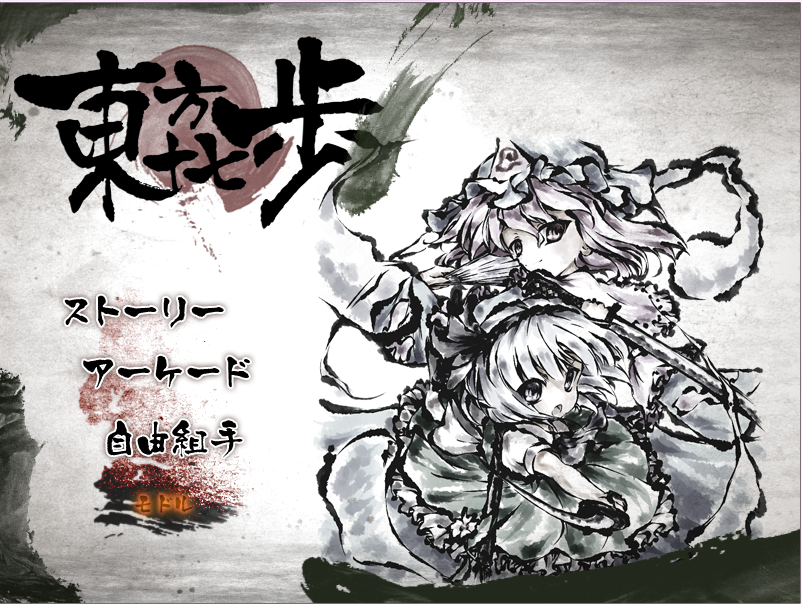
This is 東方十七歩 (Touhou Seventeen Steps would be a direct translation), or Touhou Landmine Mahjong is a better name for it.

What is Landmine Mahjong? I'm pretty sure there's a different name for it, but this is the only one I know. It's actually a concept that's new to me, and until playing this game, have never tried.

Well let's see what this game has to offer.


From the title screen, you can see four options. Pick the first one for CPU matches, the second for online matches with others, the third is options (This is in English for some reason), and the last option is exit.


The next screen has three more options. First one is Story Mode (Not working yet because this is just a preliminary version, 0.100), second is Arcade Mode (Probably the one you want to pick), and the third is free play mode, where you can pick your character and your opponent and play one match.


There are ten teams you can play as (choose by scrolling or with up and down arrow keys):

1) Border Team: Reimu & Yukari
2) Magic Team: Marisa & Alice
3) Moriya Team: Sanae, Suwako, & Kanako
4) Scarlet Devil Mansion Team: Remilia & Sakuya
5) Oni Team: Suika & Yuugi
6) Ghost Team: Youmu & Yuyuko
7) Hourai Team: Kaguya & Mokou
8) Subterranean Team: Rin & Utsuho (Orin & Okuu)
9) Komeji Team: Satori & Koishi
10) Tengu Team: Aya & Hatate

You can also see the abilities of each team; each character has their own spell card to alter the playing conditions (Such as adding a new dora indicator, hiding your discard, etc). I chose Magic Team (Their spell cards increase my fu or han) because I'm a Marisa x Alice Shipper.

When you choose your team, click on the character portrait, and an options screen appears. Since I'm strapped for time, I won't go over these options, but you should really only modify them if you know what you're doing in the first place. Click okay.


You get a nice VS screen, click again to start the game.


As you can see, this isn't your traditional Mahjong game. Here, you get a full wall to yourself (17 x 2, or 34 tiles) and from that wall you have 300 seconds to construct the best Tenpai hand you can.

Some things to note:
- The Dora indicator is the tile on the bottom right
- The blue orbs are what you press to activate your spell cards. Some you can only activate during hand construction, while others during the discarding session. The orange bar shows how much magic you have and it depletes when you use a spell card and fills the more you play.
- The rules button is the characters with the orange blob background. You can click this to go over how much certain hands are worth, etc. But this does not stop the timer.

I'll build a random hand now:


Observant people will notice that this isn't the same wall I had to begin with, as well as the top left number changing from 1 to 2. That is because there is no way to pause the game, and if you are doing something else (Such as making a blog post), the timer will eventually reach zero. When that happens, you get a randomly generated hand, which most of the time isn't in Tenpai.

Some other things to notice:
- The top now has colorful words. This indicates what conditions I have met in this hand.
- The top left above the hand shows what tiles I am waiting for.
- The blue orbs are now red. This indicates that I have used that spell card for that particular round. The orange bar depleted as a result.

When you are satisfied with the hand you made, click, then click continue. The discard portion of the game now begins:


Each player takes turns discarding tiles from their remaining wall. In this way, the only way to win is through your opponent playing into your hand; there is no Tsumo, only Ron.

This continues until either one player wins, or each player has dealt 17 tiles. If the latter, the game is a draw.

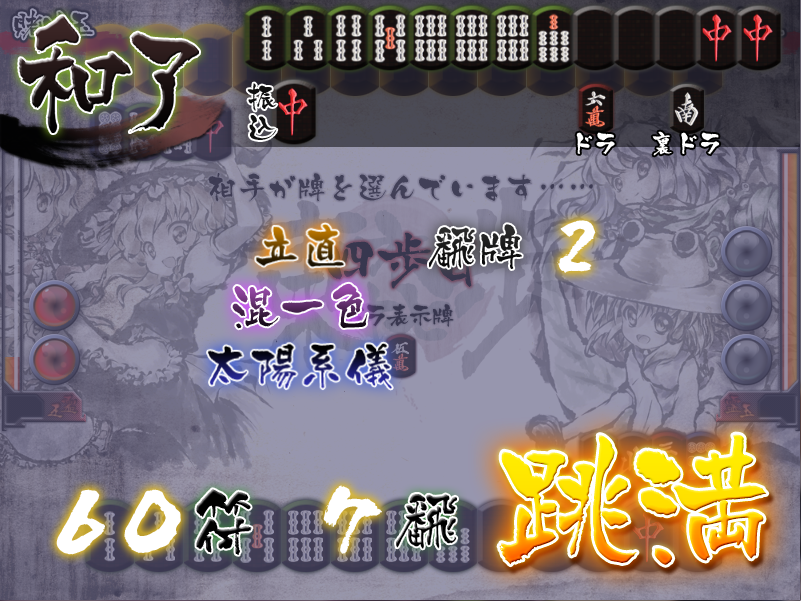
In this case I have won (obviously), and here is the results screen:


Again, it shows my conditions, as well as the Dora & Ura-Dora indicators.


Finally I take points from my opponent based on how good my hand is (We each started with 18.0). The point system is not the conventional Japanese way, but the same rule applies that a better hand gives more points.

You do this for a few more games, and then a winner is decided. Then you move on to the next opponent, regardless of whether you win or lose.

Overall this is a very fun way of playing Mahjong. This "Speed Mahjong" can help you develop your skills in hand construction, which is probably the most important skill of all in the game.

You can download the game here: http://www.mediafire.com/?pfg65qi54i5tz5a